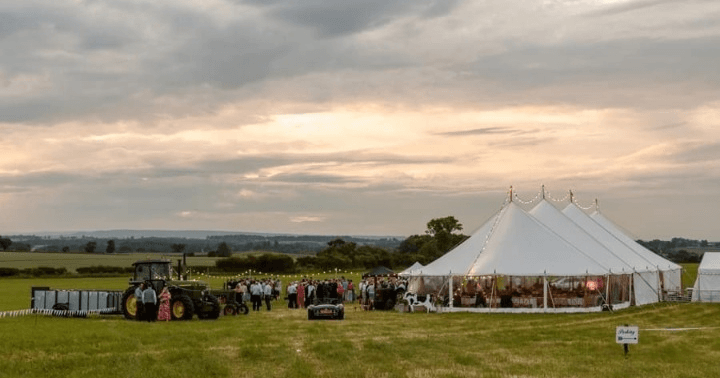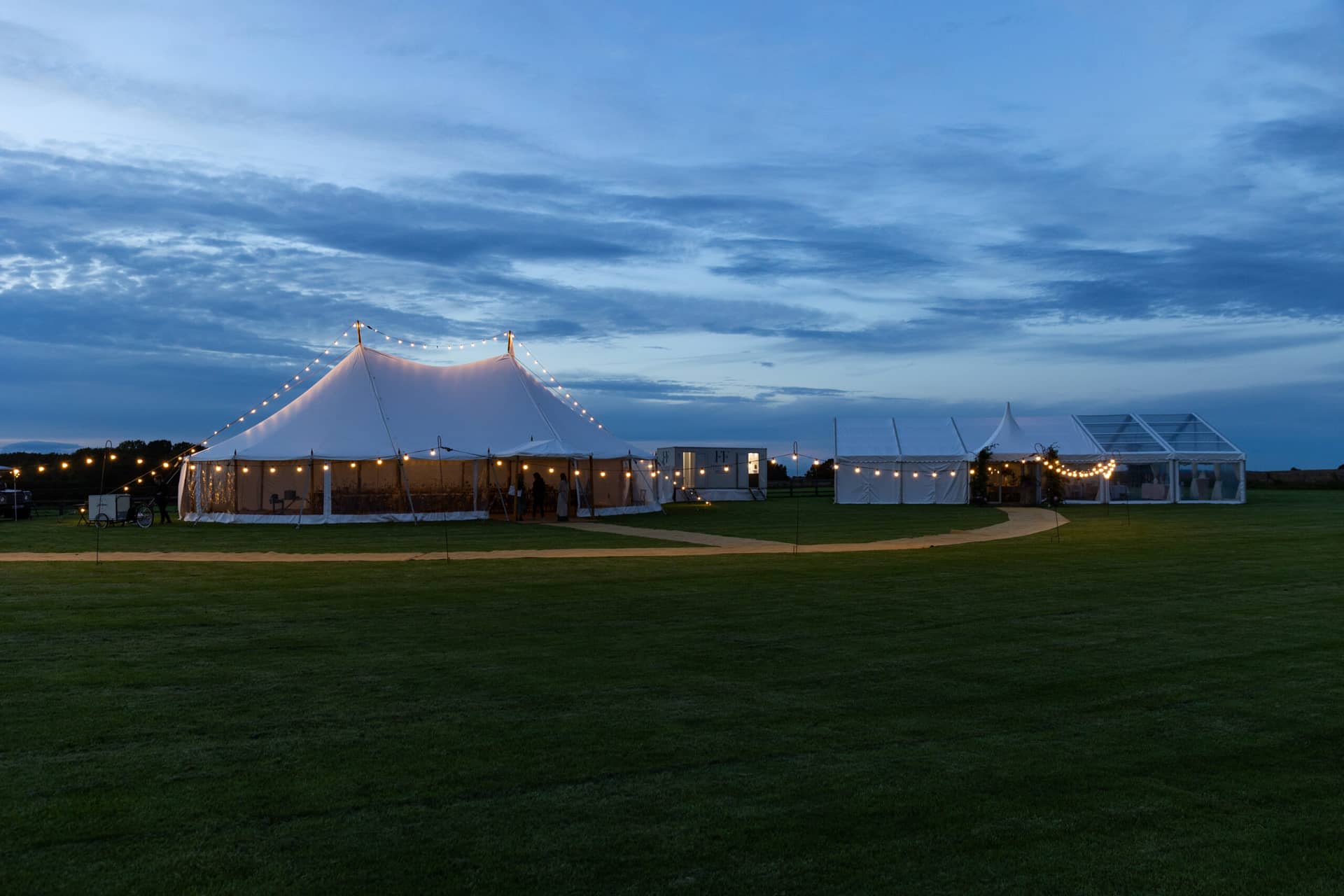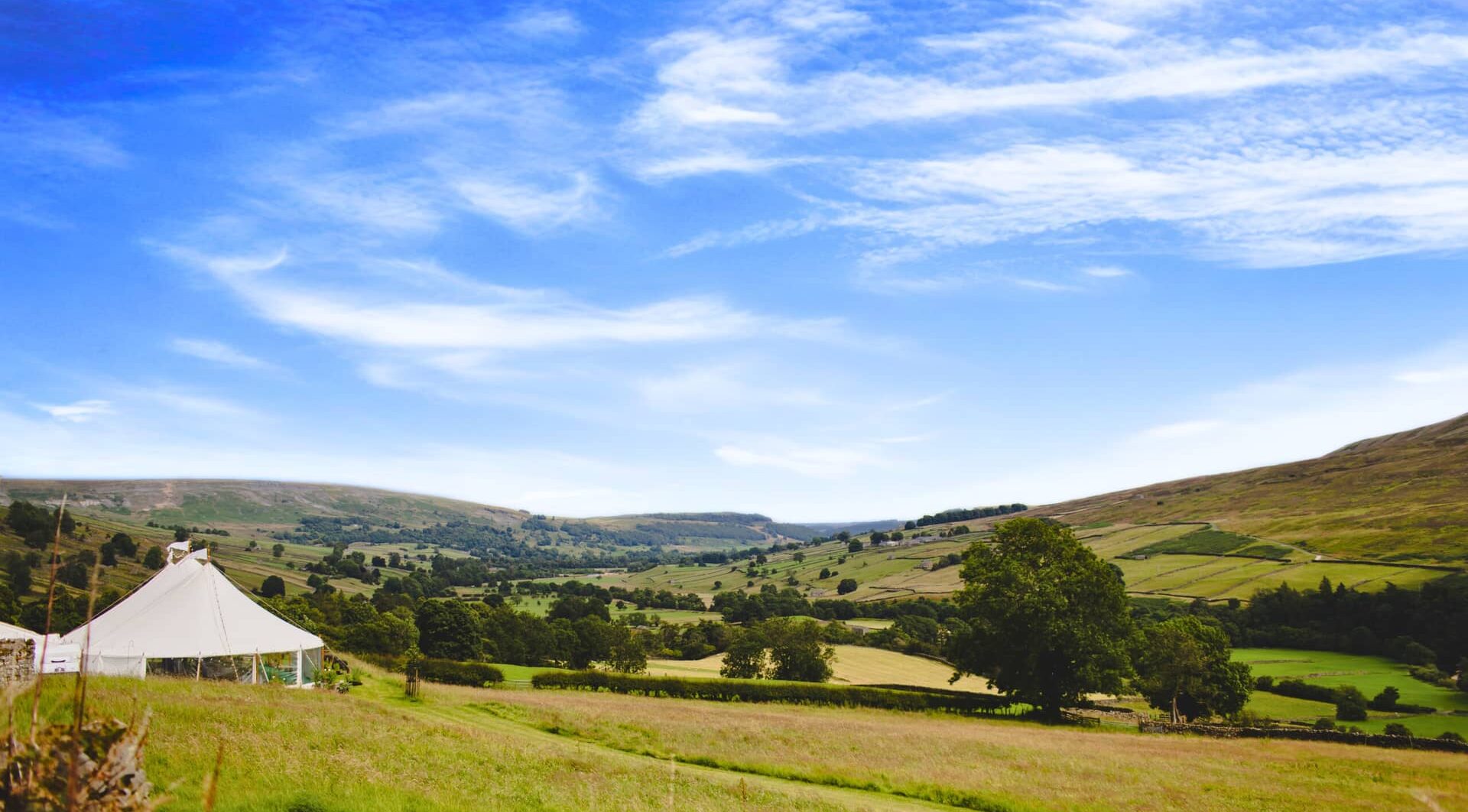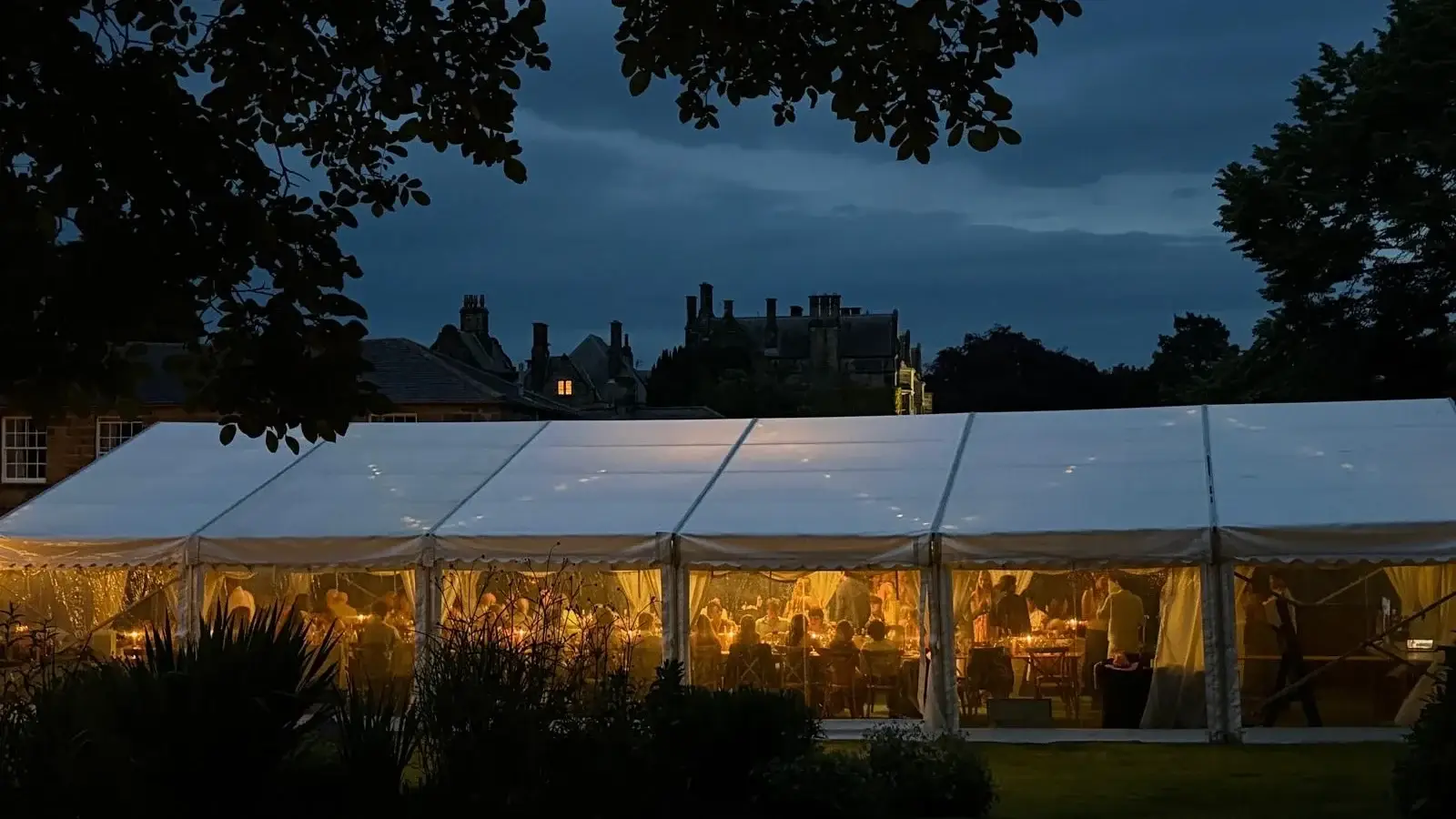
When couples first start planning a marquee wedding, they usually picture the finished result.
A beautifully dressed marquee, tables laid for their guests, a dancefloor ready for the evening and perhaps a spectacular view across the North Yorkshire countryside. What they don’t necessarily see is everything that happens beforehand to make that possible.
After more than ten years of providing marquee hire across North Yorkshire and the North East, we’ve learned that a successful wedding rarely happens by accident. It happens because someone has thought about the details.
And while every wedding is different, many of the potential problems that can arise are avoidable through good communication, careful planning and practical experience. So, what can go wrong with a marquee wedding? And perhaps more importantly, what can be done to prevent it?
Choosing the Wrong Position for Your Marquee
One of the first challenges can arise before a marquee has even been booked.
A couple might have a particular area of their garden or field in mind because it offers the most spectacular view.
But the most attractive position isn’t necessarily the most suitable.
We need to consider ground conditions, access, available space and how the marquee will sit within its surroundings.
A field that looks relatively level from a distance may have changes in gradient that become more noticeable once flooring, tables and chairs are introduced.
The position also needs to work for the type of marquee being installed.
Our Celeste sailcloth marquees require suitable grassed ground and are secured using substantial stakes, whereas our framed marquees can offer greater flexibility, including installation on suitable hardstanding using appropriate ballast.
How we prevent problems: We discuss the proposed location early and arrange a site visit where necessary. This allows us to assess the ground, access and potential marquee positions before installation arrangements are finalised.
Discovering That Access Isn’t Suitable
This is something that can easily be overlooked.
You may have a beautiful garden, paddock or field with plenty of room for a marquee.
But can the installation team get the equipment there?
At Abracadabra Marquees, our trailers are approximately eight feet wide, so we generally look for a minimum access width of ten feet.
We also need to consider turning space, gateways, trees, overhanging branches, narrow driveways and the condition of the ground.
A site that appears accessible on foot may be very different when you’re trying to manoeuvre vehicles and trailers carrying marquee equipment.
How we prevent problems: We discuss access early and assess it during a site visit where necessary. Identifying restrictions before installation allows us to establish whether the proposed position is practical.
Overlooking What’s Underneath or Above the Ground
When you’re looking across a beautiful lawn or open field, it’s easy to forget that there may be services running underneath it.
Water pipes, drainage systems and electricity cables can all influence where a marquee can safely be positioned.
Overhead power lines and other obstructions also need to be considered.
This is particularly relevant for our Celeste sailcloth marquees, which require substantial stakes to secure them.
Our Celeste marquees use stakes approximately 1.1 metres long, making it especially important to establish the location of underground services before installation.
How we prevent problems: We ask clients and landowners about known underground and overhead services and arrange for appropriate checks where required. We never want important safety information to emerge for the first time when the installation team arrives.
Underestimating How Much Space the Wedding Needs
Guest numbers are important, but they don’t tell the whole story.
A wedding for 120 guests could involve a formal seated wedding breakfast, a band, a dancefloor and a separate catering operation.
Or it could be a relaxed festival-style celebration with food trucks, informal seating and outdoor dining.
We’ve worked on a wedding where the couple wanted exactly that festival atmosphere.
With around 120 guests attending, they chose food trucks rather than traditional catering.
This meant we could plan the space differently.
We incorporated room for dancing, sofas and straw-bale seating, while also creating outdoor areas where guests could eat al fresco.
Not everyone needed to sit down for a formal meal at the same time.
The space was designed around the way the couple wanted their wedding to feel.
How we prevent problems: We ask how the day will work, rather than simply how many people are attending.
For a more detailed look at this, see our Knowledge Centre article, How Much Space Do I Really Need for a Marquee Wedding?
Leaving Furniture and Catering Decisions Too Late
This is something we’ve learned from years of working directly with couples.
Plans evolve.
Guest numbers change.
Someone decides they need an additional table.
The caterer asks for more preparation space.
A couple realises they’d like some extra chairs or a different seating arrangement.
None of these requests is unusual.
In fact, they’re part of planning a wedding.
But changes become harder to accommodate as the installation date approaches.
We regularly receive last-minute requests for additional catering tables or changes to furniture.
Where possible, we’ll always try to help.
However, the earlier these requirements are identified, the easier it is to incorporate them into the plan.
How we prevent problems: We maintain communication with clients during the countdown to their event and encourage them to discuss supplier requirements and layout changes as early as possible.
Forgetting About Power, Toilets and Other Essentials
A marquee can create a beautiful venue almost anywhere suitable, but a field doesn’t automatically come with the facilities of a traditional wedding venue.
You may need to arrange:
- Electrical power for lighting, catering and entertainment
- Suitable toilet facilities
- Heating if required
- Access for caterers and other suppliers
- Appropriate lighting outside the marquee
- Safe and practical routes between different areas
The important thing is to consider these elements as part of the overall event rather than separate decisions.
A generator, for example, needs to be suitable for the equipment it will supply.
Toilet facilities need to be positioned where guests can reach them comfortably.
And suppliers need to know how and when they can access the site.
At Abracadabra, we can help clients coordinate many of these requirements alongside the marquee itself.
Not Having a Plan for the Weather
One of the most common questions we’re asked is:
“What happens if it rains?” It’s understandable, particularly when planning an outdoor wedding in Yorkshire.
The purpose of a marquee is to provide a sheltered space, but good weather planning goes beyond keeping the dining tables dry.
What happens when guests walk from the marquee to the toilets? Where will people wait if food is being served outside?
Is there enough covered space if guests who were planning to sit outdoors need to come inside? What happens to vehicle access if the ground becomes wet?
These questions are worth discussing before the wedding.
We’ve seen first-hand how valuable this can be.
For a recent 90-guest celebration, we worked with a client to ensure their marquee could accommodate an outdoor bar inside if the weather deteriorated.
It gave the family the freedom to enjoy their original outdoor plans while having a practical alternative ready.
We’ll explain more about that experience later in this article.
How we prevent problems: We consider the weather, ground conditions and site layout during planning, monitor conditions around installation and make safety-led decisions when necessary.
No marquee company can control the British weather. But experience helps us prepare for it.
Assuming All Suppliers Will Automatically Work Around Each Other
A marquee wedding often involves several different suppliers.
The marquee company, caterers, florists, furniture providers, entertainment, bar suppliers and other contractors may all need access to the same space.
If everyone assumes they can arrive whenever they like, difficulties can arise.
For example, the flooring may need to be completed before furniture can be installed.
The furniture needs to be positioned before tables can be dressed.
The caterer may need access to their working area before the event.
And the florist may have particular requirements for decorating the marquee.
These activities need to happen in a sensible order.
How we prevent problems: We work with clients to understand their suppliers’ requirements and the sequence in which different parts of the installation need to take place.
Because Abracadabra can provide marquees, flooring, furniture, lighting and dancefloors, we’re often able to coordinate several important elements of the installation together.
Discovering Something Has Been Forgotten on Installation Day
This is one of the less glamorous parts of marquee hire, but it’s something we take seriously.
A wedding installation involves a substantial amount of equipment.
Marquee components, flooring, carpets, lighting, tables, chairs and other items all need to arrive at the correct location.
And they need to arrive at the right time.
That’s why we have a system in place when our teams load equipment.
Every team member signs to confirm the items they have loaded onto the trailer.
This creates accountability and helps us check that everything required for the installation has been included.
It’s a simple operational discipline, but it makes a difference.
Clients may never see these checks taking place.
They simply expect their marquee and equipment to arrive as arranged.
And that’s exactly why the preparation matters.
Michael’s Golden Rule
“The easiest installations aren’t the quickest — they’re the ones that were prepared properly before anyone left the yard.”
Not Allowing Enough Time Before the Wedding
One of the biggest advantages of a marquee wedding is the freedom to create your own venue.
But that venue still needs to be built.
And once the marquee is installed, there may be other work to complete.
Furniture needs arranging.
Tables need dressing.
Flowers and decorations need installing.
Catering equipment needs preparing.
Entertainment may need setting up and testing.
The exact sequence depends on the wedding, but it’s important to allow sufficient time for each stage.
How we prevent problems: We agree installation arrangements with clients and encourage early discussions about when other suppliers need access. A well-planned schedule helps everyone work efficiently without unnecessary pressure.
From Years in the Field: Planning for the Weather Without Compromising the Event
One of the most important lessons we’ve learned from years of building marquees across North Yorkshire is that good contingency planning doesn’t mean compromising on what the client wants.
Sometimes it’s simply about making sure there’s another option if circumstances change.
A recent 21st birthday celebration is a perfect example.
We were approached by a family planning their daughter’s 21st birthday party for around 90 guests.
They wanted a framed marquee that would primarily be used for dining, with a separate outdoor bar and a dancing area in the woodland next to the marquee.
It was a lovely idea, making the most of the outdoor setting while creating different spaces for guests to enjoy throughout the evening.
The family had chosen our rustic round bar as a feature of the celebration, with the intention of positioning it outside the marquee.
But there was one important consideration.
What would happen if it rained? Creating a Plan B Without Losing Plan A
Rather than simply hoping for good weather, we worked with the client to ensure the framed marquee was large enough to accommodate the bar inside if necessary.
This meant the original plan could go ahead, but there was also a practical alternative.
If the weather turned against us, the bar could be positioned inside the marquee, allowing guests to continue enjoying the celebration without getting wet while ordering drinks.
It was a relatively simple decision during the planning stage, but one that could have made a significant difference on the day.
Making the Final Decision
As the installation date approached, we reviewed the weather forecast before the marquee build.
The forecast was sufficiently favourable for us to proceed with the original layout, keeping the rustic round bar outside.
The family could enjoy the arrangement they had originally imagined, with dining in the marquee, the outdoor bar and dancing in the neighbouring woodland.
And importantly, we had already considered what we would do if the weather hadn’t been on our side.
The result was a very happy client.
What This Experience Taught Us
The lesson isn’t that you should always book a bigger marquee just in case it rains.
It’s that your marquee layout should reflect both your preferred plans and any sensible contingencies.
Sometimes that means allowing enough room for an outdoor feature to be moved inside.
Sometimes it means reconsidering the position of a bar, catering area or seating.
And sometimes it simply means having a conversation early enough to give yourself options.
For couples planning a marquee wedding in North Yorkshire, this is particularly relevant when incorporating outdoor bars, food trucks, entertainment or relaxed seating areas.
You can still create the outdoor celebration you’ve imagined.
But it’s worth considering what will happen if the weather has other ideas.
Michael’s Golden Rule
“A good Plan B should be worked out before you need it — not when the rain starts.” That’s the value of forward planning. It allows clients to enjoy their original vision, knowing that practical alternatives have already been considered.
Good Planning Should Make Your Wedding Feel Easier, Not More Complicated
Reading about all these considerations might make planning a marquee wedding sound complicated.
But the reality is that couples don’t need to become experts in marquee installations.
That’s our job.
You should be able to concentrate on the exciting decisions — your guests, your food, your music, your decorations and the atmosphere you want to create.
Our role is to help you understand the practical requirements and guide you through the process.
Whether you’re planning a wedding at home, on a farm or at a private estate in North Yorkshire, the right preparation can make a significant difference.
At Abracadabra Marquees & Events, we believe that good communication, careful planning and practical experience are just as important as the marquee itself.
Because when the big day arrives, the last thing you want to be thinking about is whether everything has been planned properly.
You want to enjoy your wedding.
And that’s what all the preparation is for.
Frequently Asked Questions
What are the most common problems when planning a marquee wedding?
Common challenges include unsuitable ground, restricted access, overlooked underground services, insufficient space, last-minute changes and poor coordination between suppliers. Many can be addressed through early planning and appropriate site assessments.
Can a marquee be installed on sloping ground?
Some sloping sites may be suitable, depending on the gradient, marquee type and ground conditions. A site visit helps determine whether there is an appropriate position for the installation.
What happens if it rains during my marquee wedding?
A properly installed marquee provides shelter, but it’s also important to consider access routes, outdoor catering, toilets and seating areas. We recommend planning for wet weather even if your wedding takes place in summer.
How far in advance should I arrange a marquee site visit?
It’s sensible to discuss the site early in the planning process, particularly if you’re considering a farm, private estate or location with uncertain access or ground conditions.
Can I change my furniture requirements after booking?
We understand that wedding plans can change. We’ll do our best to accommodate adjustments, subject to availability and practical requirements. The earlier changes are discussed, the easier they are to manage.
Do I need to organise a separate company for flooring, furniture and lighting?
Not necessarily. Abracadabra can provide marquee flooring, carpets, tables, chairs, lighting, dancefloors and a range of other event equipment, allowing several elements to be planned together.
Do you offer marquee hire across North Yorkshire?
Yes. Abracadabra Marquees & Events provides wedding marquee hire across North Yorkshire and the wider North East, including Northallerton, Thirsk, Richmond, Ripon, Harrogate, York and surrounding rural areas.